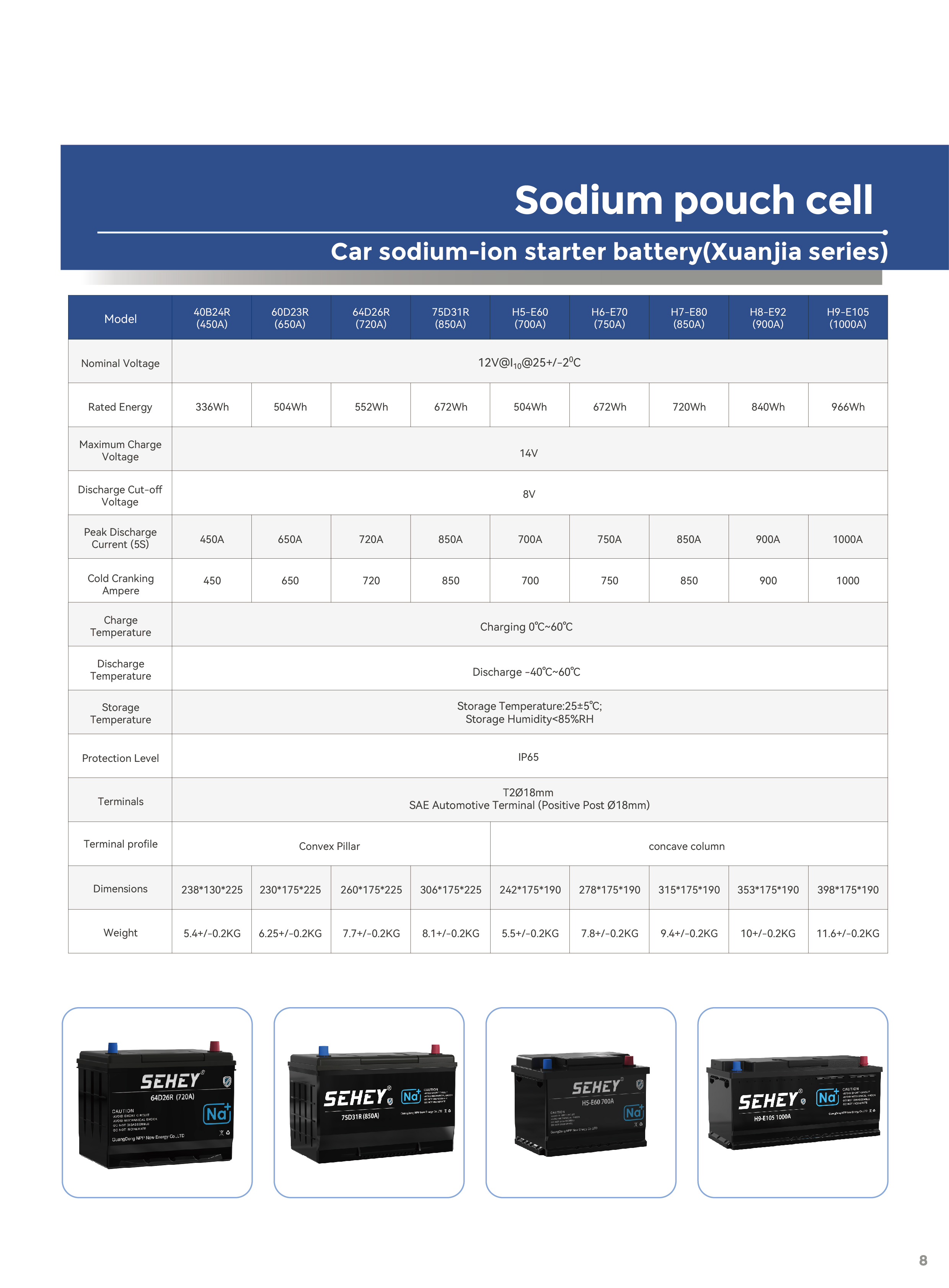
1.The sodium-ion starting battery, as a new generation of energy storage technology, converts electrical energy through the intercalation/de-intercalation mechanism of sodium ions (Na⁺) between the positive and negative electrodes. Its fundamental principle is highly similar to that of lithium-ion batteries, but it uses sodium resources to replace the scarce lithium resources as active materials. Compared to traditional lead-acid batteries (energy density ≤ 40 Wh/kg, cycle life of 300-500 cycles) and some lithium iron phosphate battery solutions (which show significant low-temperature performance degradation), sodium-ion batteries demonstrate three core advantages:
Ultra low temperature resistance, ultra fast charging
Ultra-lightweight and long warranty
Safe and redundant, green and environmentally friendly
1.Sodium-ion starter battery is a new type of secondary battery based on the migration of sodium ions (Na+) between the positive and negative electrodes to achieve charge and discharge, which works similarly to lithium-ion batteries, but with abundant sodium resources as the core material. In recent years, with the advancement of technology, sodium-ion batteries have shown great potential in the field of starting power (such as automobiles, ships, construction machinery, etc.), and have become a cost-effective alternative to traditional lead-acid batteries and some lithium battery solutions.
2.The real disruptive power of sodium-ion batteries lies in the reconstruction of the pyramid structure of battery materials - when the energy storage system shifts from "performance priority" to "cost-safety-sustainability" multi-dimensional balance, sodium battery is creating a technical paradigm different from lithium batteries with its "absolute cost advantage that does not rely on cobalt-nickel-lithium and reliability redundancy in V2X scenarios". This technical route is not only suitable for start-stop power supply, but also may give rise to the explosive growth of new application scenarios such as distributed energy storage and low-speed electric vehicles.